
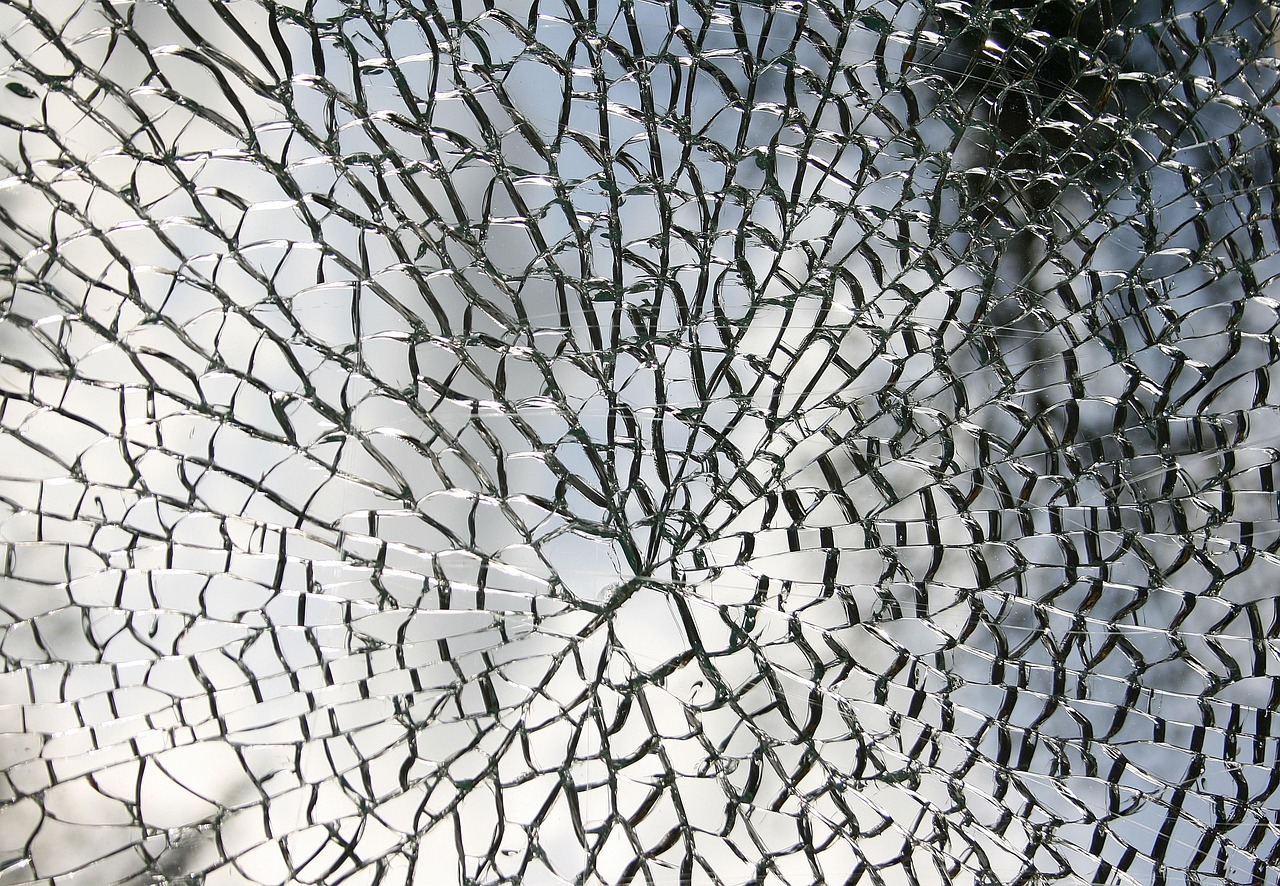
You’re sitting in your office when a floor-to-ceiling window suddenly shatters — without warning, without impact, and without any obvious cause. No rock. No equipment. Nothing. Just a loud crack and a cascade of glass.
It sounds like something out of a thriller, but spontaneous glass breakage is a real and well-documented phenomenon — one that building owners, facility managers, and commercial tenants should understand. More importantly, there are practical and technically recognized measures available to help manage the risks associated with these events before they become a safety or liability concern.

What Is Spontaneous Glass Breakage?
Spontaneous glass breakage (also called “spontaneous breakage” or “self-breakage”) occurs when a pane of glass fractures without any apparent external impact or direct applied force. It is most commonly associated with tempered (toughened) glass, which is widely used in commercial buildings, curtain walls, storefronts, office partitions, and doors — precisely the environments NGS serves every day.
When tempered glass breaks spontaneously, it typically shatters into thousands of small fragments rather than the large, jagged shards produced by annealed glass. While this break pattern is intentionally designed to reduce severe laceration hazards, the event can still create significant risks — particularly in high-rise and public-facing environments where falling glass may affect pedestrians, occupants, or adjacent property.
Why Does Glass Break Spontaneously?
Several factors are known to cause or contribute to spontaneous glass breakage in commercial settings.
1. Nickel Sulfide (NiS) Inclusions
One of the most well-known causes of spontaneous breakage in tempered glass is nickel sulfide (NiS) inclusions — microscopic contaminants that can form during the glass manufacturing process. These tiny crystalline particles exist in two phases: a high-temperature phase and a low-temperature phase. During the rapid cooling (quenching) process used to temper glass, NiS inclusions can become “frozen” in their high-temperature phase. Over time — sometimes years or even decades after installation — they can slowly revert to their lower-temperature phase, expanding slightly in the process.
That expansion, although microscopic, can under certain conditions create internal stresses sufficient to initiate a fracture from within the glass itself. The result can be a pane that appears perfectly intact one day and is fractured the next.
Industry experience indicates that the majority of NiS-related breakage events tend to occur within the earlier years of a building’s service life, particularly in glass that was not heat soak tested during manufacturing. Properly heat-soaked tempered glass is generally considered to present substantially lower residual NiS risk than non-heat-soaked glass.
2. Thermal Stress
Glass expands when heated and contracts when cooled. In commercial buildings, different portions of a glass pane can experience dramatically different temperatures simultaneously — for example, the sun-exposed center of a pane versus edges partially shaded by framing systems. This uneven thermal expansion creates internal stress within the glass.
Under certain conditions, those stresses may exceed the strength capacity of the glass, leading to fracture without any direct external impact. Buildings with significant solar exposure, dark-framed glazing systems, HVAC vents near windows, or substantial thermal cycling may be more susceptible to thermally induced glass breakage.
While thermal stress fractures differ technically from latent NiS inclusion failures, both can result in sudden glass breakage events that appear to occur without warning.
3. Edge Damage During Fabrication or Installation
Even minor chips, scratches, or micro-cracks along the edge of a glass pane — sometimes introduced during cutting, transport, handling, or installation — can become stress concentration points. Over time, thermal cycling, building movement, or normal structural loading can propagate those imperfections until the glass ultimately fails.
4. Frame Stress and Building Movement
Commercial buildings move. Wind loads, thermal expansion, foundation settlement, and normal structural deflection can all transfer stress into glazing systems. If glass is installed too tightly within its frame, or if glazing materials lose flexibility over time, stress may concentrate within the pane itself.
How Common Is Spontaneous Glass Breakage?
Precise failure rates vary depending on glass quality, manufacturing controls, heat soak testing practices, exposure conditions, and building design. However, industry professionals generally recognize spontaneous breakage as a realistic operational consideration in buildings containing large quantities of tempered glass.
In large commercial buildings with hundreds or thousands of tempered glass panels, even statistically infrequent events can become meaningful over the life of the building. High-rise curtain wall systems, spandrel glazing, storefront systems, and façades exposed to substantial solar loading or thermal cycling are among the environments commonly associated with spontaneous glass breakage concerns.
The Real Risk: What Happens When Glass Fails?
The safety and financial consequences of spontaneous glass breakage can be significant:
- Personal injury from falling glass, particularly on upper floors or in public-facing environments
- Liability exposure for building owners and property managers
- Emergency replacement costs, which can be substantial for custom or specialty glazing
- Operational disruption — a broken curtain wall panel may require temporary protection or restricted access while replacement glass is fabricated
- Reputational damage, particularly for retail, hospitality, healthcare, educational, or institutional facilities
How Window Film Helps Manage the Risk
This is where safety and security window film can play a meaningful role — and it is one of the most frequently sought after retrofit tools available to building owners and facility managers.
Window film does not prevent spontaneous glass breakage from occurring. The underlying mechanics of NiS inclusions, thermal stress, or edge-related failure are not eliminated by film applied to the glass surface. What properly selected safety film can do, however, is materially improve post-break fragment retention and help reduce the immediate hazards associated with falling glass.
Glass Fragment Retention
The most direct benefit of safety and security window film is fragment retention. A properly installed safety film bonds to the glass surface and helps hold fractured glass fragments together following breakage. Rather than individual fragments immediately shedding from the opening, the broken pane may remain substantially more cohesive for a period of time following failure.
The degree of retained-glass stability depends on several factors, including:
- The type of glazing system
- Whether the system is single-pane or insulated glass (IGU)
- Framing geometry and glass capture depth
- Glass size and thickness
- Film specification and optional attachment method
This retained condition can significantly reduce immediate fallout hazards and may provide building management with valuable time to coordinate controlled replacement procedures rather than responding to an uncontrolled emergency condition.
The duration and stability of any retained condition depends on the specific glazing geometry, framing system, edge-seal condition, film configuration, attachment method, and post-break environmental loading. Long-term retention cannot be guaranteed, and fractured glazing should still be replaced promptly once identified.
Why Insulating Glass Units (IGUs) Matter
In many modern dual-pane insulating glass units (IGUs), spontaneous fracture of the outer pane does not immediately create an open breach in the building envelope because the inner pane remains intact. In these systems, the glazing assembly itself may continue substantially functioning as the primary pressure and weather barrier even after outer-lite fracture.
Under these conditions, safety film can work together with the glazing system, framing geometry, and insulating glass edge seals to help maintain temporary retention of fractured outer-glass fragments long enough for identification and controlled replacement.
The duration and stability of any retained condition depends on the specific glazing geometry, framing system, edge-seal condition, film configuration, and post-break environmental loading.
Protection from Secondary Hazards
In high-rise or curtain wall applications, spontaneous breakage without fragment retention can allow glass debris to fall into pedestrian areas, plazas, atriums, adjacent roofs, or occupied spaces below. Safety film can significantly reduce this risk by helping limit immediate fragment fallout.
Retrofit Solution — No Replacement Required
One of the most practical advantages of window film is that it is a retrofit solution. Existing glazing does not necessarily need to be replaced in order to gain additional fragment-retention capability. Film can be applied to many existing glazing systems — including tempered, annealed, laminated, and insulated glass units — with relatively limited disruption to building operations.
For facilities with aging curtain walls or large quantities of tempered glass that would be cost-prohibitive to replace proactively, safety film may offer a practical and comparatively cost-effective risk-mitigation measure.
Complementary Benefits
Modern safety and security films may also provide additional building-performance benefits:
- Solar control: Reduce heat gain and UV exposure, potentially lowering cooling costs and helping protect furnishings
- Glare reduction: Improve occupant comfort, particularly in open-plan office environments
- Security enhancement: Certain safety films may also contribute to delayed forced-entry resistance or blast-fragment mitigation when properly specified
- Energy efficiency: Some film systems may contribute toward sustainability and energy-management goals

What Building Owners Should Consider
If your building contains significant amounts of tempered glass — particularly in curtain wall systems, storefronts, atriums, spandrel conditions, or high-traffic public areas — a proactive evaluation of spontaneous breakage exposure may be worthwhile.
Heat soak testing is one recognized preventative measure used during manufacturing. It involves holding tempered glass at elevated temperatures for a controlled period in order to trigger many unstable NiS-related failures before installation. However:
- Heat soak testing is not universally specified,
- many older buildings contain non-heat-soaked tempered glass,
For existing installations, safety and security window film is often one of the most practical retrofit mitigation measures available. A qualified glazing or film specialist can evaluate the existing glazing system, assess risk conditions, and recommend appropriate film specifications, attachment systems, and installation methods based on the building’s specific conditions and objectives.
Frequently Asked Questions About Spontaneous Glass Breakage
Can window film prevent spontaneous glass breakage?
No. Window film does not prevent the breakage event itself. It helps manage the consequences of breakage by improving fragment retention and reducing the likelihood of immediate falling-glass hazards.
What type of film is best for spontaneous breakage protection?
Safety and security films designed for fragment retention are generally used for these applications. The appropriate specification depends on the glazing type, installation location, panel size, framing system, and overall risk profile of the building.
Is window film effective on tempered glass?
Yes. Safety film can be applied to tempered, annealed, laminated, and insulated glass units. For tempered glass specifically, fragment retention can be particularly valuable because tempered glass tends to fracture into numerous small pieces following spontaneous breakage.
How long does window film last?
Professional-grade window film, when properly installed and maintained, typically has a service life of 10 or more depending on product selection, environmental exposure, and climate conditions.
Does window film affect the appearance of the glass?
Modern safety films are available in a wide range of optical characteristics, including options that are nearly invisible. Some products may also provide additional solar-control, decorative, or privacy functionality depending on the building’s objectives.
Improve Commercial Glazing Safety with NGS
At NGS, we have spent decades working with commercial building owners, facility managers, government agencies, school districts, and institutions across the country to deliver glazing safety and sustainability solutions designed to help protect people and property.
Our team brings experience in safety film specification and installation across a wide range of environments, including high-rise commercial buildings, aviation facilities, educational institutions, healthcare properties, and government facilities. We understand that every glazing system is different, and we work with clients to identify practical solutions appropriate for their specific building conditions, operational concerns, and budget objectives.
If your building contains tempered glass panels, or if you’ve experienced spontaneous breakage and want to evaluate ways to help reduce the associated risks, we encourage you to speak with one of our specialists.